BigCommerce Alternatives 2026: Which Shop System Really Fits You
BigCommerce alternatives compared: predictable costs without forced tier jumps, a stronger checkout and a bigger app ecosystem. With a clear recommendation.

Richard Roth
SEO & GEO Strategist
August 20, 2026
8 min read
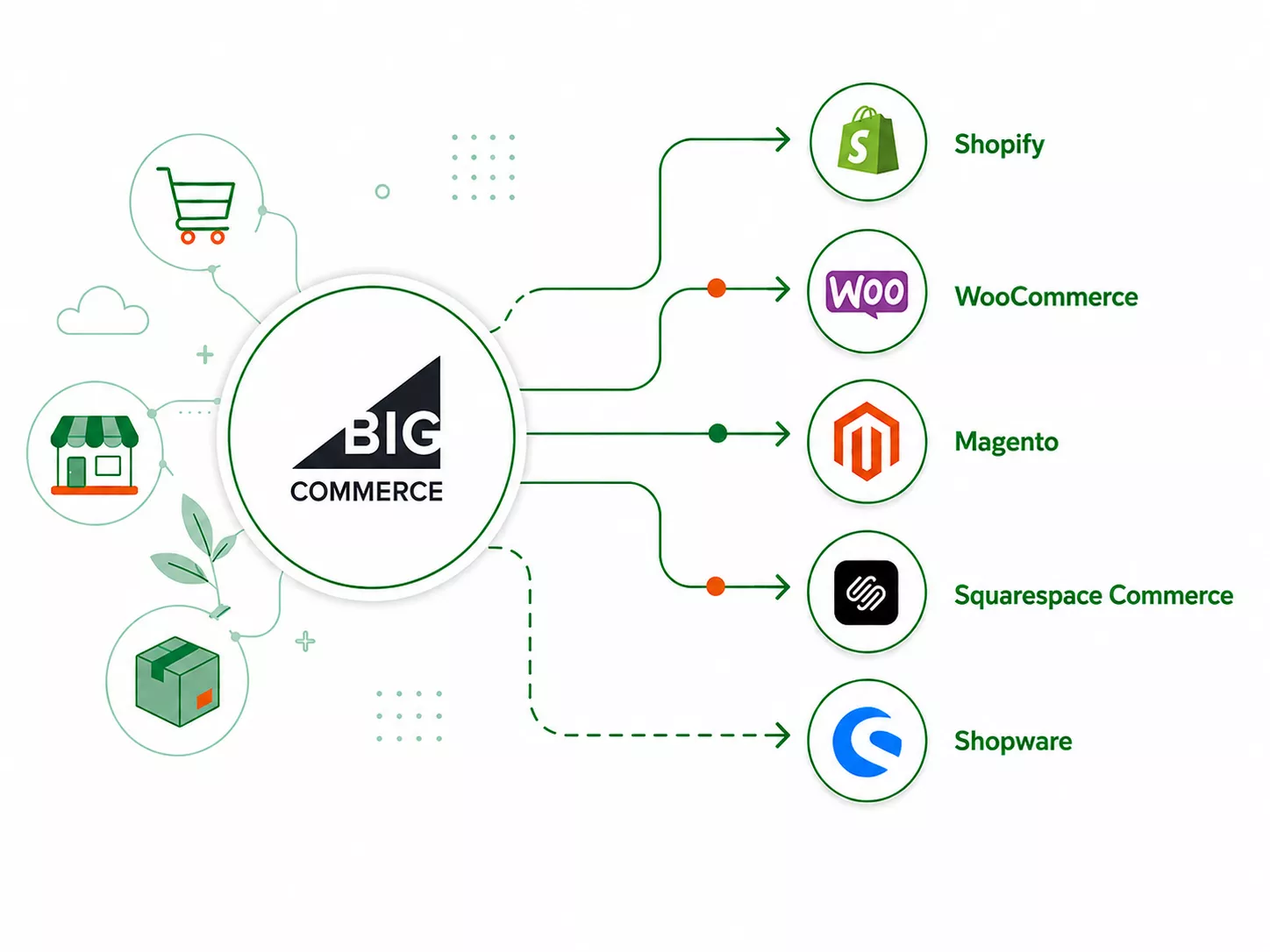
BigCommerce is a solid, hosted platform, so maintenance isn’t the issue. The reasons to switch are different: plan jumps as soon as your revenue crosses a threshold, a smaller ecosystem than the competition and little adoption in the DACH region. Anyone who feels those looks around.
Let’s look at the best BigCommerce alternatives: what they can do, where their limits are and which system really pays off for whom.
- • Shopify is the most direct alternative: the same maintenance-free SaaS idea, but with a larger ecosystem, a stronger checkout and no forced plan jumps at revenue thresholds.
- • The most common reason to switch is exactly that plan jump: BigCommerce automatically bumps you into the next tier at certain annual revenues.
- • WooCommerce is the option if you want to work open source and content-driven and don't shy away from maintenance.
- • Squarespace and Wix fit small, design-driven shops, Adobe Commerce very large enterprise B2B.
- • BigCommerce's strength stays the large native feature scope out of the box. The question is whether ecosystem and checkout give you more elsewhere.
Why do merchants switch from BigCommerce?
Not because of the operation, since that runs. The sore point is the pricing model: BigCommerce ties its plans to your annual revenue and automatically bumps you into the next tier at certain thresholds. As you grow, costs jump, regardless of whether you need more features.
On top of that come a smaller app and theme ecosystem than Shopify’s, a checkout considered less conversion-strong, and thin adoption in the German-speaking region when it comes to agencies, apps and local payment methods. For many, the sum of these points is the trigger.
When merchants ask me about BigCommerce, the plan jump is almost always the real trigger, not a missing feature. My advice is to map where your next revenue threshold sits before you commit anywhere, because that single number often decides whether a move even pays off. Shopify tends to win here less on functionality and more on cost predictability plus the DACH ecosystem you’ll actually lean on day to day.
The best BigCommerce alternatives at a glance
Because BigCommerce is a hosted platform, most merchants want something maintenance-free again. Moving to a self-hosted system would be a step back for them.
| Platform | Type | From price/month | Hosting | Best for |
|---|---|---|---|---|
| Shopify | SaaS (hosted) | from 36 € | included | A direct switch with a larger ecosystem and stronger checkout |
| WooCommerce | Self-hosted (WordPress) | from hosting cost | your own | Content-driven shops that want open source |
| Squarespace | SaaS (hosted) | from ~36 € | included | Small, design-driven shops |
| Wix | SaaS (hosted) | from ~30 € | included | Very small shops with a simple catalog |
| Adobe Commerce (Magento) | Self-hosted / PaaS | high license/year | your own | Very large, custom enterprise B2B |
The alternatives in detail
Shopify: the direct switch
Shopify and BigCommerce are very similar as hosted SaaS platforms, but in exactly the points BigCommerce merchants care about, Shopify is ahead.
- No plan jump on revenue. Shopify prices its plans as flat monthly fees rather than tying them to revenue, so costs stay more predictable.
- Larger app ecosystem. More and more mature apps for standard cases, less custom development.
- Better checkout. Shopify’s checkout is considered industry-leading and often lifts conversion.
On top of that comes the much stronger adoption in the DACH region: more agencies, more local payment methods, more matching apps. It shows in the numbers too: in our Core Web Vitals shop system study, 81.8% of Shopify shops pass the mobile benchmark, against 69.2% of BigCommerce shops. For most BigCommerce shops, the switch is a win in flexibility and conversion without giving up maintenance freedom.
First check which BigCommerce plan currently holds you and at what revenue the next jump looms. Our ecommerce platform calculator puts exactly that cost curve next to the Shopify costs.
WooCommerce: open source and content-strong
If you want to move away from a closed SaaS system, WooCommerce is the open alternative, especially with a content focus.
- Strength: huge plugin ecosystem, WordPress leading on content and blog.
- Weakness: you give up maintenance freedom, hosting, security and updates become your job.
- For whom: content-driven shops that deliberately want to work open source.
Squarespace and Wix: for small, design-driven shops
If your shop is small and the website is central, these hosted builders are a simpler, cheaper option.
- Strength: very simple, design-strong, no maintenance.
- Weakness: limited ecommerce depth, quickly hit limits on catalog and scaling.
- For whom: small shops with a manageable catalog. Anyone who wants to grow is better off with Shopify.
Adobe Commerce: for the very largest B2B
If you’re moving toward enterprise with highly custom B2B, Adobe Commerce (Magento) plays in its own league.
- Strength: maximum depth for complex enterprise processes.
- Weakness: high license, infrastructure and development costs, self-hosting instead of SaaS.
- For whom: large merchants with their own dev team. Shopify isn’t automatically the better choice here.
BigCommerce vs. Shopify: the direct comparison
| Criterion | BigCommerce | Shopify |
|---|---|---|
| Model | SaaS, hosted | SaaS, hosted |
| Entry cost | from ~35 €/month | from 36 €/month |
| Plans | forced upgrade at revenue thresholds | no revenue-based forced jumps |
| App and theme ecosystem | smaller | large and mature |
| Checkout | solid | industry-leading, conversion-strong |
| Adoption in the DACH region | low | high |
| Best for | many native features out of the box | ecosystem, checkout and flexibility |
Read the detailed comparison in Shopify vs. BigCommerce, and see all systems in the ecommerce platform comparison.
Which alternative fits whom?
| Your profile / requirement | Recommendation |
|---|---|
| Predictable costs, larger ecosystem, strong checkout | Shopify |
| Open source and content-driven | WooCommerce |
| Small, design-driven shop | Squarespace or Wix |
| Very large, custom enterprise B2B | Adobe Commerce |
For most BigCommerce shops the road leads to Shopify, because you keep the same maintenance freedom but get more ecosystem, a stronger checkout and more predictable costs.
What does switching from BigCommerce cost?
As a SaaS-to-SaaS move, the switch is usually simpler than from a self-hosted system, but it still depends on catalog and customizations. So there’s no fixed flat price.
The ecommerce platform calculator shows how your costs develop, especially with an eye on the plan jumps. And as an agency specialized in Shopify migration with over 45 moves, we make sure product data, redirects and rankings carry over cleanly. How it works for BigCommerce is on our BigCommerce to Shopify migration page.
Conclusion: which BigCommerce alternative fits you?
For most BigCommerce shops, Shopify is the best alternative. You keep maintenance freedom but get a larger ecosystem, the stronger checkout and more predictable costs without forced plan jumps. In the DACH region especially, Shopify is much better supported.
If you want to work open source, WooCommerce is the alternative, for very small shops Squarespace or Wix are enough, and for the very largest B2B, Adobe Commerce is worth a look.
Not sure whether the switch pays off? We migrate your BigCommerce shop at a fixed price and make sure data and rankings survive the move. Get your free analysis.
 Frequently Asked Questions
 What is the best BigCommerce alternative?
Why does BigCommerce force me into a pricier plan?
Is Shopify better than BigCommerce?
Is migrating from BigCommerce to Shopify complex?
You might also like
Volusion Alternatives 2026: Modern, Future-Proof and Conversion-Strong
Volusion alternatives compared: a modern, future-proof system with a strong checkout and active ecosystem instead of an outdated base. With a recommendation.
Webflow Alternatives 2026: The Shop Systems Actually Worth It
Webflow alternatives compared: real selling depth with subscriptions and more payment methods, while the strong design and CMS stay. With a recommendation.
Jimdo Alternatives 2026: The Strongest Alternatives Compared Head-to-Head
Jimdo alternatives compared: a real shop system with subscriptions, more payment methods and ERP integration instead of builder limits. With a recommendation.