
JTL Alternatives 2026: Switch the Shop, Keep Wawi and WMS
JTL alternatives compared: replace the JTL shop with Shopify and keep JTL-Wawi and WMS via a connector, or replace the backend entirely.

Richard Roth
SEO & GEO Strategist
August 5, 2026
15 min read
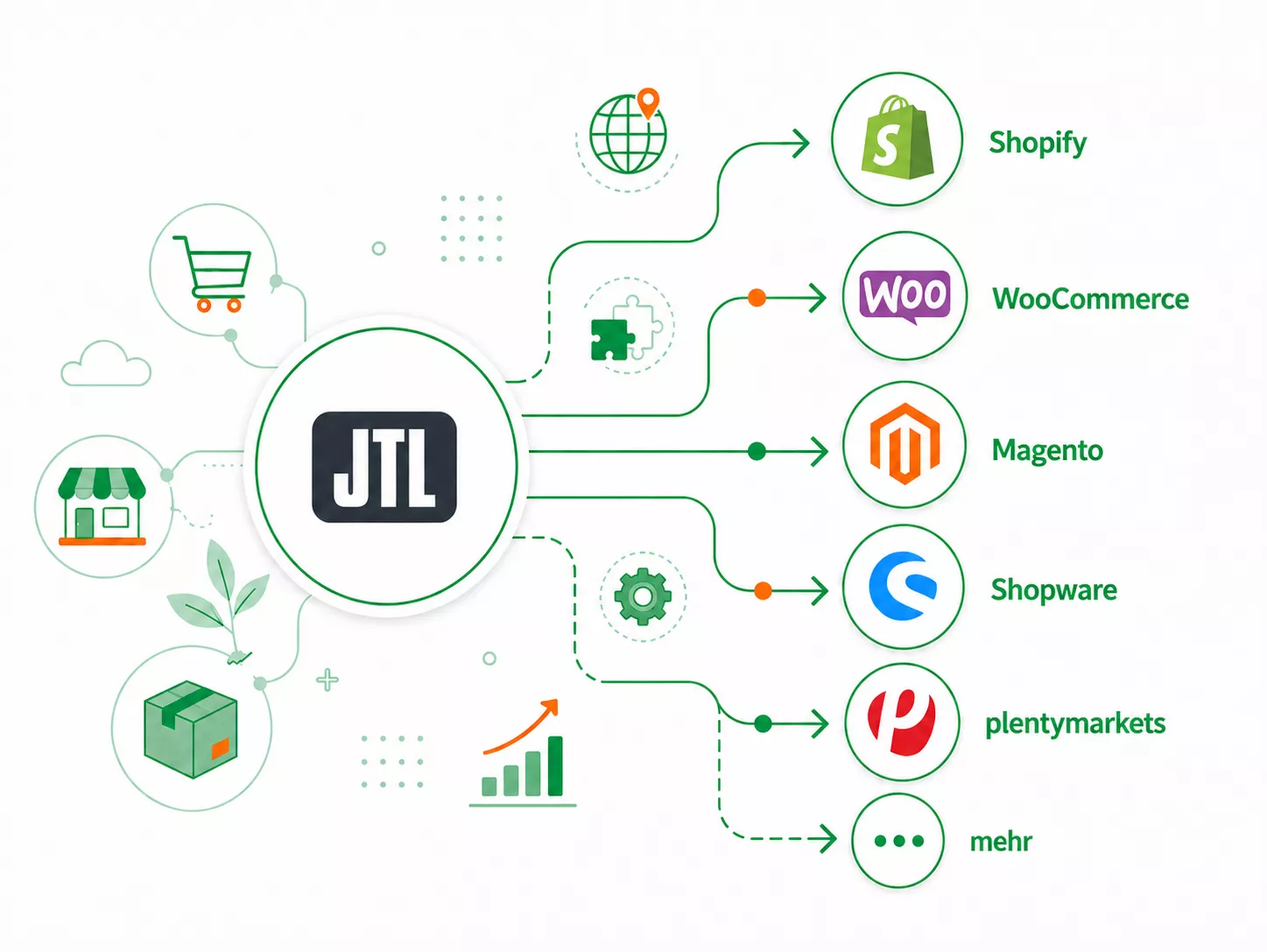
JTL is widely used in German retail, but “JTL” is not a single product, it’s a whole suite. That’s why the question of an alternative is trickier than it sounds. Three building blocks work together: the JTL-Shop as the storefront, JTL-Wawi as the inventory management and ERP core, and JTL-WMS as the warehouse management that sits on top of the Wawi. Wawi and WMS form a backend package, and the shop is the storefront in front of it.
So a “JTL alternative” can mean three things: a new shop, a new backend (Wawi plus WMS), or both. Let’s look at both sides: the shop alternatives like Shopify and the backend alternatives like Xentral, Afterbuy and Billbee. What they can do, where their limits are and which path really pays off for whom.
- • JTL is a suite: JTL-Shop (storefront), JTL-Wawi (inventory/ERP) and JTL-WMS (warehouse management, sits on top of the Wawi). First clarify which block you want to replace.
- • For most, replacing the shop is enough: JTL-Shop out, Shopify in, and JTL-Wawi plus WMS stay connected via a connector.
- • If you also want to replace the backend, Xentral, Afterbuy, Billbee, plentyONE and (internationally) Odoo are the relevant Wawi and multichannel alternatives.
- • Shopware and Plentymarkets make sense depending on your profile: Shopware for self-hosted B2B, Plentymarkets as a hosted all-in-one with an ERP core.
- • JTL's strength remains its native, mature inventory management with WMS in the German market. The only question is whether your shop frontend still carries it.
Why do merchants look for a JTL alternative?
Most don’t switch because of inventory management, but because of the shop around it. The JTL-Shop is self-hosted, and the Wawi ecosystem is powerful but complex.
Four reasons come up again and again in practice:
- Self-hosting and updates: Servers, security and updates for shop and Wawi stay your responsibility.
- Technical hurdle: The Wawi ecosystem is complex, and many changes require a service partner.
- Frontend and conversion: The JTL storefront feels more technical and less modern, which costs conversion.
- Longer time-to-market: Setup and changes including Wawi coordination take longer than with a hosted platform.
The bottom line: the JTL-Shop is free, but the ongoing operation of hosting, service partner and customisations is not. So it pays to look at the alternatives, especially because you don’t have to give up your Wawi. That many merchants take this step is shown by our analysis of shop system market shares: JTL lost around 31% of its footprint from 2024 to 2026, while Shopify grew by almost 21%.

The crux of JTL moves is rarely the shop, it’s the Wawi connection. Before we lift a JTL shop onto Shopify, we first clarify which connector handles article, stock and order synchronisation and how your attributes and variants are mapped in Shopify. We always test this coordination on a test system with real Wawi data first, otherwise your stock levels tip over after go-live.
Which JTL block do you want to replace: shop, Wawi or all of it?
Before you compare systems, make the real decision first. Because JTL consists of shop and backend, there are three paths:
- Replace only the shop: Your frontend should become more modern and maintenance-free, but JTL-Wawi and JTL-WMS run well. Then you look for a shop system like Shopify and connect your existing backend via a connector. This is the case for most JTL merchants.
- Replace only the backend: The shop is fine, but inventory and warehouse management should get leaner or cloud-based. Then you look for a Wawi or multichannel alternative like Xentral, Afterbuy or Billbee.
- Replace both: You leave the JTL world entirely and combine a modern storefront with a new backend.
For most, it comes down to path 1, because JTL-Wawi with WMS is a strong, well-run backend. You modernise the storefront and keep your processes.
How do you recognise a good JTL alternative?
Whichever path you take, judge every candidate against the same criteria:
- Total cost: Shop, hosting, support and inventory management combined.
- Scalability: Does the platform keep up with growth and traffic or order peaks?
- Usability: How much can you do yourself, without a service partner?
- Maintenance effort: Who handles updates, security and operations?
- Inventory and warehouse: Can your ERP and WMS logic be connected or cleanly mapped?
- Time-to-market: How fast are you live and can push changes?
The best JTL-Shop alternatives at a glance
If what bothers you is mainly the self-hosted frontend, you replace the JTL-Shop. Full-grown platforms qualify as alternatives:
| Shop system | Type | From price/month | Hosting | Best for |
|---|---|---|---|---|
| Shopify | SaaS (hosted) | from 36 € | included | Modern storefront, JTL-Wawi stays connected via connector |
| Shopware | Self-hosted | CE free | yourself | Self-hosted B2B in the DACH mid-market |
| Plentymarkets | SaaS (hosted) | from ~200 € | included | All-in-one with an ERP and multichannel core |
| WooCommerce | Self-hosted (WordPress) | from hosting costs | yourself | Content-driven shops on WordPress |
| BigCommerce | SaaS (hosted) | from ~35 € | included | SaaS fans with many native features |
Which one fits depends mainly on one question: should inventory management sit inside the shop system, or stay connected as its own system?
The shop alternatives in detail
Shopify: modern frontend, inventory management stays
Shopify is a SaaS platform: hosting, updates and security are included in the price. The best part for JTL merchants: you only modernise the storefront and keep your existing JTL-Wawi plus WMS connected.
Strengths:
- Keep the backend. JTL-Wawi and JTL-WMS can be connected to Shopify via the official JTL connector. You modernise the frontend and keep your processes.
- No self-hosting operation. Shopify handles updates, scaling and security, instead of your own server maintenance.
- Modern, fast frontend. A storefront that converts better than the more technical JTL storefront.
Where the limits are: You give up the tight, single-source integration of shop and Wawi. In return you separate cleanly: a proven backend at the back, a modern selling experience at the front.
Best for: JTL merchants who want to keep their processes but get a better, maintenance-free storefront.
Before you switch, a sober cost comparison pays off. In our shop system calculator, you can see in a few minutes what JTL costs you in total operation across hosting and support and where Shopify saves.
Shopware: self-hosted B2B in the DACH region
Shopware is an API-first system, especially strong in the B2B mid-market in German-speaking countries.
- Strength: Highly customisable, full code control, strong B2B features.
- Weakness: Self-hosted like JTL, you swap one operational effort for the next.
- Best for: Merchants who stay self-hosted but want a more modern, flexible system than the JTL-Shop.
Plentymarkets: all-in-one with an ERP core
If what matters to you about JTL is mainly the combination of shop and inventory management, Plentymarkets (plentyONE) is an obvious candidate.
- Strength: ERP, multichannel and marketplaces as a native core, all in one hosted system.
- Weakness: High complexity, steep learning curve and a frontend that often becomes a weak spot itself.
- Best for: Merchants looking for a hosted all-in-one solution with a strong ERP focus.
WooCommerce: for the content focus
WooCommerce is an open-source plugin for WordPress and strong when your business runs on content and SEO.
- Strength: Very flexible, huge plugin ecosystem, leading for content and blogging.
- Weakness: Self-hosted like JTL, security, updates and performance stay your job.
- Best for: Shops already on WordPress that put content at the centre.
BigCommerce: the hosted SaaS alternative
BigCommerce is hosted like Shopify and brings many features natively.
- Strength: Many native features, multichannel and B2B, no maintenance load.
- Weakness: Smaller app ecosystem than Shopify and lower adoption in the DACH region.
- Best for: Merchants who want SaaS and value many built-in features.
Can you keep your JTL-Wawi and JTL-WMS and still switch?
Yes, and this is exactly the decisive point for most JTL merchants. JTL-Wawi is a standalone system for warehouse, orders and accounting, and JTL-WMS is the warehouse management module that sits on top of it for picking, multi-warehouse and mobile scans. Neither is tied firmly to the JTL-Shop.
Via the official JTL connector, this backend can also be connected to a Shopify store. Orders, stock and article data then keep running through your familiar Wawi plus WMS, while a modern, fast Shopify storefront sits at the front. So you separate cleanly between what works well (your processes and warehouse logic) and what slows you down (the old frontend and the self-hosting operation).
For many merchants, this is the most convenient path: they keep their well-run backend and still gain a better selling experience, without a break in daily business.
Do you also want to replace JTL-Wawi and JTL-WMS?
Some merchants don’t just want to modernise the shop, but move the whole backend to the cloud and get rid of the Wawi complexity. Then you replace JTL-Wawi and JTL-WMS with a cloud-based ERP or multichannel system. These candidates are relevant and all connect natively to Shopify:
| System | Type | Focus | Best for |
|---|---|---|---|
| Xentral | Cloud ERP | Inventory, warehouse, fulfilment, pre-accounting | Growing D2C brands in the DACH region |
| Afterbuy | Cloud multichannel/ERP | Inventory, warehouse, marketplaces centralised | Marketplace-heavy merchants |
| Billbee | Cloud multichannel | Order, invoice and shipping handling | Small to mid-sized multichannel merchants |
| plentyONE | Hosted all-in-one | ERP plus its own shop | Those who want everything in one system again |
| Odoo | Modular full ERP | Full business software | International, many business areas in one |
- Xentral is a cloud-native ERP with a native Shopify connection and a warehouse module (serial numbers, batches, best-before dates, multi-warehouse) that covers JTL’s WMS functions in a cloud model.
- Afterbuy is a cloud multichannel inventory system with ERP, warehouse and central marketplace management (Amazon, eBay, Kaufland, OTTO), especially for marketplace-heavy merchants.
- Billbee is the lean option via the Shopify interface and more than 150 further connections, more order and shipping handling than a full ERP.
- plentyONE is the obvious choice if you deliberately want an all-in-one of ERP and shop again, instead of separating backend and storefront.
- Odoo connects via a Shopify connector and pays off if you want to bundle far more than e-commerce in one system.
For most JTL merchants, the least friction path is still: keep JTL-Wawi and JTL-WMS and only lift the shop onto Shopify. Replacing the backend entirely is a bigger project that mainly pays off when the Wawi itself has become the bottleneck.
JTL vs Shopify: the direct comparison
For the shop question, this is the decisive comparison. Here is the short version:
| Criterion | JTL | Shopify |
|---|---|---|
| Model | Self-hosted shop plus JTL-Wawi and WMS | SaaS, fully hosted |
| Entry cost | shop free, but hosting and operation | from 36 €/month, all included |
| Hosting and updates | yourself, for shop and Wawi | included, automatic |
| Maintenance effort | high (self-hosted, updates) | minimal |
| Inventory and warehouse | JTL-Wawi with WMS as native core | JTL-Wawi and WMS connectable via connector |
| Frontend and conversion | functional, more technical | modern, fast |
| Time-to-market | setup including Wawi takes time | quickly live |
| Best for | merchants with JTL-Wawi at the centre | modern storefront without operational load |
You will find the detailed head-to-head with all the details on inventory management, costs and frontend in our article Shopify or JTL in direct comparison. For an overview of all common systems, see the shop system comparison.
Which alternative pays off for whom?
The right choice depends on your profile, not on a blanket winner.
| Your profile / requirement | Recommendation |
|---|---|
| Modern storefront, Wawi and WMS stay | Shopify (JTL backend via connector) |
| Inventory management must stay fully inside the shop system | Plentymarkets or stay with JTL |
| Backend should become cloud-based and leaner | Xentral or Afterbuy |
| Small to mid-sized multichannel merchant | Billbee plus Shopify |
| Self-hosted B2B in the DACH region | Shopware |
| Strong WordPress and content focus | WooCommerce or Shopify |
For the largest share of JTL merchants, the path leads to Shopify, because you keep your processes and warehouse logic and still get a modern, maintenance-free storefront.
What does switching from JTL cost?
It depends on the size of your shop, the number of products, your Wawi and WMS processes and the desired connection. So there is no fixed flat price.
Two things help you get a sense of it. First, the shop system calculator, which shows you what your current system costs you in total operation. Second, our experience as an agency specialised in Shopify migration from over 45 moves: a clean switch is predictable when data, the Wawi connection, redirects and rankings are considered from the start. How this works specifically for JTL, you can read on our page about JTL to Shopify migration.
Clarify early which processes stay in JTL-Wawi and WMS and which the shop takes over. A clean division of tasks between backend and Shopify saves you double maintenance later.
Conclusion: which JTL alternative fits you?
For most JTL merchants, Shopify is the best alternative. You keep your JTL-Wawi plus WMS and only modernise the storefront, hand off self-hosting and maintenance and get a fast, conversion-strong frontend. Your processes keep running, just with a better selling experience in front.
If you also want to replace the backend, Xentral, Afterbuy, Billbee, plentyONE or Odoo are the right candidates. If, on the other hand, inventory management should sit entirely inside the shop system, Plentymarkets can fit or staying with JTL may remain sensible. And whoever wants self-hosted control will find in Shopware a more modern system than the JTL-Shop.
Not sure whether the switch pays off for your shop? We migrate your JTL shop at a fixed price, connect your inventory management and make sure data and rankings survive the move. Get your free analysis.
 Frequently Asked Questions
 What is the best JTL alternative?
Do JTL-Wawi and JTL-WMS belong together?
Can I keep using my JTL-Wawi and WMS with Shopify?
What alternatives are there to JTL-Wawi itself?
Is Shopify better than JTL?
What does moving from JTL to Shopify cost?
You might also like
Plentymarkets Alternatives 2026: Replace the Shop, the ERP or Both
Plentymarkets alternatives compared: ERP and multichannel tools like Xentral, Billbee and JTL-Wawi and shop systems like Shopify. With a clear recommendation.
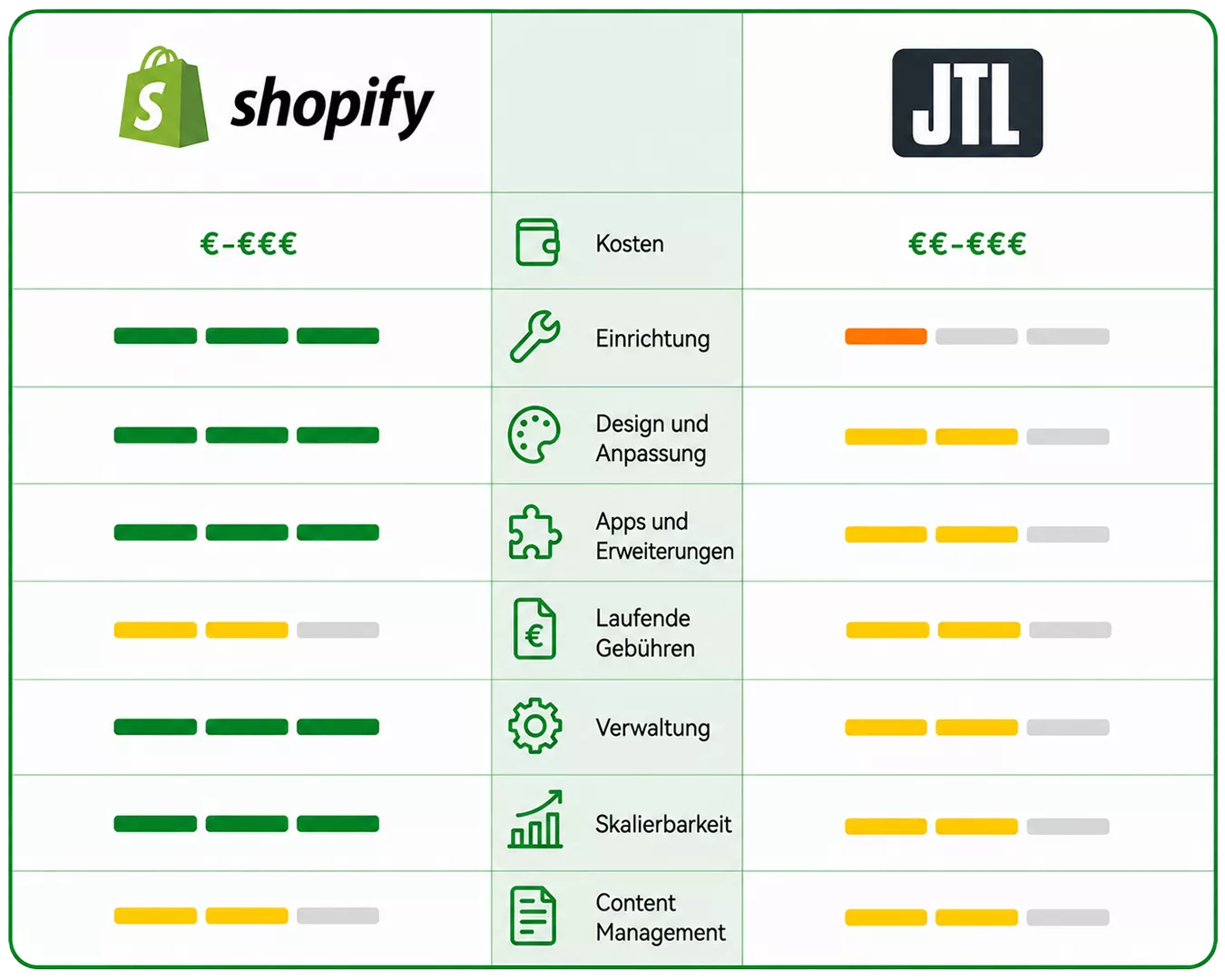
JTL vs Shopify: Direct Comparison 2026
JTL vs Shopify in direct comparison. Costs, hosting, ERP connection and scaling. Find out which system fits your store.
Volusion Alternatives 2026: Modern, Future-Proof and Conversion-Strong
Volusion alternatives compared: a modern, future-proof system with a strong checkout and active ecosystem instead of an outdated base. With a recommendation.