OXID Alternatives 2026: Solid B2B, Low-Maintenance Operations
OXID alternatives compared: without expensive OXID specialists or upgrade projects, and B2B stays fully doable. Which system suits which shop.

Richard Roth
SEO & GEO Strategist
August 23, 2026
8 min read
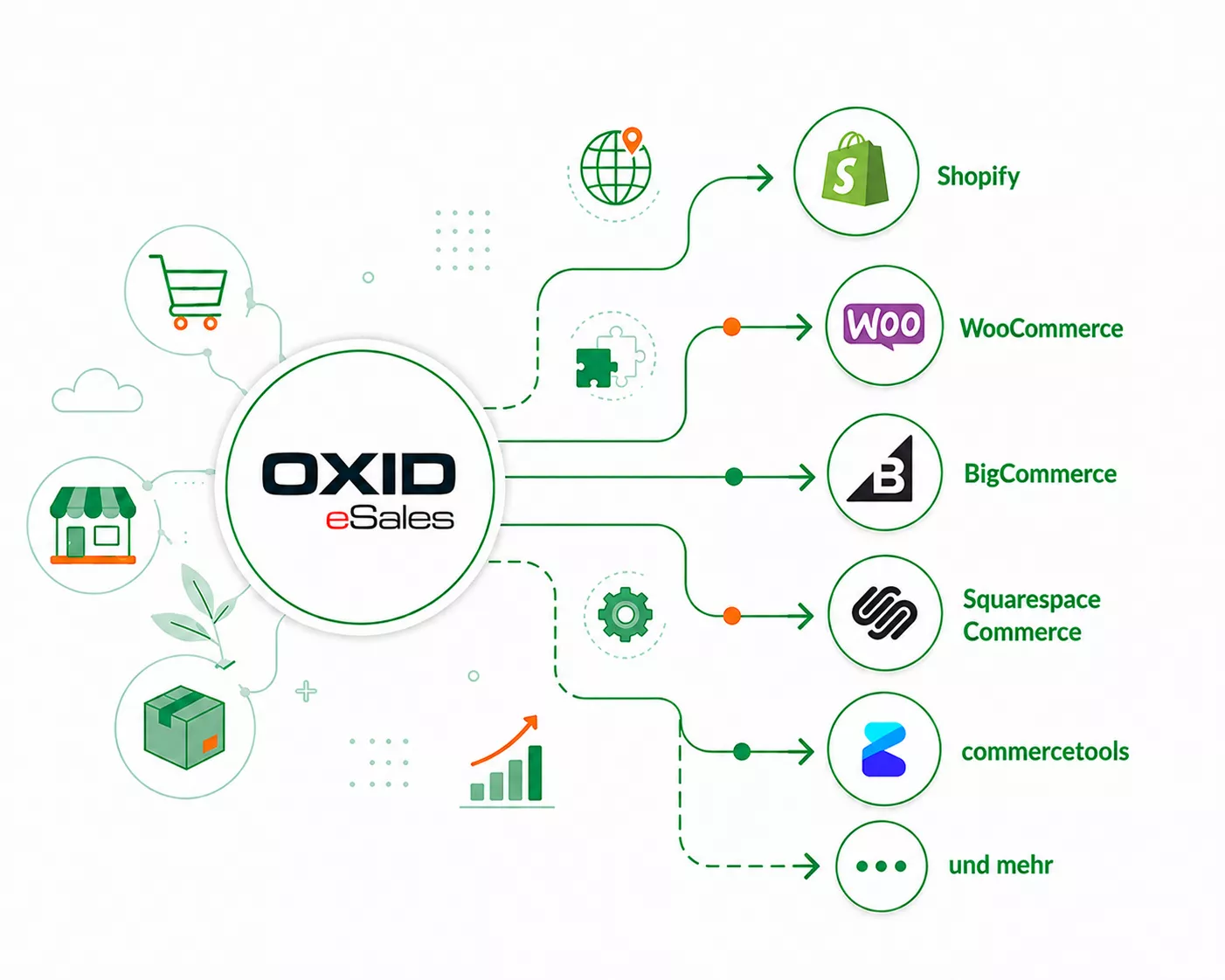
OXID eShop is firmly rooted in German B2B and can do a lot. The catch shows up in daily life: self-hosting, regular upgrades and dependence on specialized developers who are scarce and expensive. That’s where many merchants start thinking about an alternative.
Let’s look at the best OXID alternatives: what they can do, where their limits are and which system really pays off for whom.
- • Shopify takes self-hosting, upgrades and operation off your plate and delivers speed and stability without needing OXID specialists.
- • Your B2B stays: customer groups, individual pricing and approvals are covered via Shopify B2B and apps.
- • Shopware is the obvious alternative if you deliberately want to stay self-hosted in DACH B2B.
- • Adobe Commerce and Spryker are the exceptions upward: for very large, highly custom enterprise B2B, Shopify isn't automatically the best choice.
- • OXID's strength stays the customizable DACH B2B. The question is whether that depth is worth the high operating effort and developer dependency to you.
Why do OXID merchants look for an alternative?
Rarely because features are missing. It’s the operation. OXID is self-hosted, upgrades are projects, and for customizations you need OXID-experienced developers who are hard to find and priced accordingly. That dependency is the real pain point: if no specialist is available, your shop stops too.
On top of that come license costs in the Professional and Enterprise editions plus ongoing hosting and support costs. The Community Edition is free, but the total operation is anything but cheap. You’re not alone in reconsidering: our shop system market share study records a 39.1% drop in OXID’s share between 2024 and 2026, the steepest decline in the field.

The specialist dependency is what I’d flag hardest with OXID. On paper it’s a capable, customizable B2B system, but in practice your uptime is tied to a small, expensive pool of developers who actually know it. When one of your custom modules breaks and no one’s available, you’re stuck. Before you migrate, catalog your B2B logic honestly, customer groups, tiered pricing, approvals, quoting, because most of it maps onto Shopify B2B plus a couple of apps, and that’s usually a far leaner thing to keep running.
What an OXID alternative has to deliver
The core is simple: less operating effort and less specialist dependency, without giving up your B2B. Concretely that means predictable total costs, a system where standard changes run without developers, and a clean transfer of your B2B logic and your rankings.
The best OXID alternatives at a glance
| Platform | Type | From price/month | Hosting | Best for |
|---|---|---|---|---|
| Shopify | SaaS (hosted) | from 36 € | included | B2B merchants who want to lose operation and developer dependency |
| Shopware | Self-hosted | CE free | your own | Self-hosted B2B in the DACH mid-market |
| Adobe Commerce (Magento) | Self-hosted / PaaS | high license/year | your own | Very large, custom enterprise B2B |
| Spryker | Self-hosted / composable | high license | your own | Highly custom composable commerce |
| BigCommerce | SaaS (hosted) | from ~35 € | included | SaaS fans wanting native B2B features |
The alternatives in detail
Shopify: hand off operation, keep B2B
Shopify is hosted, with updates and security included from 36 euros a month. For OXID merchants that solves two problems at once: the self-hosting effort and the dependency on scarce specialists.
- No self-hosting and no upgrade projects. OXID upgrades and server operations tie up developers, Shopify updates automatically.
- Less specialist dependency. You ship standard changes without OXID developers.
- B2B stays. Customer groups, individual pricing and approvals are covered via Shopify B2B and apps, from a leaner setup.
For most OXID shops that’s a clear win in speed and predictability, without the B2B requirements falling behind.
Before switching, list your most important B2B requirements: customer groups, tiered pricing, approval workflows, quoting. That quickly shows what Shopify B2B covers natively and where you need an app.
Shopware: the self-hosted peer alternative
If you’d rather stay self-hosted, Shopware is the natural switch in DACH B2B.
- Strength: modern, API-first, highly customizable, strong B2B features.
- Weakness: self-hosted like OXID, you trade one operating effort for the next, though with better developer availability.
- For whom: merchants who want self-hosted control but a more modern, more broadly supported system.
Adobe Commerce and Spryker: for the very largest B2B
Both play in the enterprise league. Adobe Commerce (Magento) stands for maximum depth in complex B2B, Spryker for composable commerce with its own frontend.
- Strength: the highest customization for very large, demanding setups.
- Weakness: the highest total cost from license, infrastructure and team.
- For whom: corporations with their own dev team. Shopify isn’t automatically the better choice here.
BigCommerce: hosted with B2B features
BigCommerce is a SaaS alternative with native B2B features if you want to move away from self-hosted but not to Shopify.
- Strength: hosted, many native features, no maintenance load.
- Weakness: smaller ecosystem and less adoption in the DACH region.
- For whom: SaaS fans who value built-in B2B features.
OXID vs. Shopify: the direct comparison
| Criterion | OXID eShop | Shopify |
|---|---|---|
| Model | Self-hosted, CE/PE/EE | SaaS, fully hosted |
| Entry cost | CE free, PE/EE with license | from 36 €/month, all included |
| Hosting and upgrades | your own, upgrades as projects | included, automatic |
| Maintenance | high | minimal |
| Developers | OXID specialists needed, scarce and expensive | standard without a developer, large community |
| B2B | strong natively (PE/EE) | strong via Shopify B2B and apps |
| Best for | customizable DACH B2B with dev resources | B2B without an operating and specialist load |
Read the detailed comparison in Shopify vs. OXID, and see all systems in the ecommerce platform comparison.
Which alternative fits whom?
| Your profile / requirement | Recommendation |
|---|---|
| Lose operation and developer dependency, keep B2B | Shopify |
| Deliberately stay self-hosted in DACH B2B | Shopware |
| Very large, highly custom enterprise B2B | Adobe Commerce or Spryker |
| SaaS with native B2B features | BigCommerce or Shopify |
For most OXID shops the road leads to Shopify, because operation and specialist dependency fall away without the B2B suffering.
What does switching from OXID cost?
It depends on your B2B processes, the catalog and the degree of customization. So there’s no fixed flat price.
The ecommerce platform calculator shows what OXID costs you across the whole operation. And as an agency specialized in Shopify migration with over 45 moves, we know that B2B migrations in particular have to be prepared cleanly, from customer groups to rankings. How it works for OXID is on our OXID to Shopify migration page.
Conclusion: which OXID alternative fits you?
For most OXID shops, Shopify is the best alternative. You hand off self-hosting, upgrades and the dependency on scarce specialists and keep your B2B via Shopify B2B and apps. That lowers running costs and makes the operation predictable.
If you want to stay self-hosted, Shopware is the more modern successor. And for very large, highly custom enterprise B2B, Adobe Commerce or Spryker play to their strengths.
Not sure whether the switch pays off? We migrate your OXID shop at a fixed price, map your B2B cleanly and make sure data and rankings survive the move. Get your free analysis.
 Frequently Asked Questions
 What is the best OXID alternative?
Can I take my B2B from OXID to Shopify?
Is Shopify better than OXID?
What does switching from OXID to Shopify cost?
You might also like
Volusion Alternatives 2026: Modern, Future-Proof and Conversion-Strong
Volusion alternatives compared: a modern, future-proof system with a strong checkout and active ecosystem instead of an outdated base. With a recommendation.
Webflow Alternatives 2026: The Shop Systems Actually Worth It
Webflow alternatives compared: real selling depth with subscriptions and more payment methods, while the strong design and CMS stay. With a recommendation.
Jimdo Alternatives 2026: The Strongest Alternatives Compared Head-to-Head
Jimdo alternatives compared: a real shop system with subscriptions, more payment methods and ERP integration instead of builder limits. With a recommendation.